Charlie Enright (Bristol, RI, USA) skippers the 11th Hour Racing Team during The Ocean Race Leg 1 on their way to Cabo Verde (Image: January 15, 2023, Carlo Borlenghi/The Ocean Race)
NEWPORT, RI (January 20, 2023) – An international fleet of foil-assisted IMOCA 60-foot sailboats started The Ocean Race last weekend in Alicante, Spain. They were soon tacking through the Strait of Gibraltar against gale-force winds, then turning left and speeding down the coast of Africa.
In four months time and with 24,800 nautical miles of ocean in their wake, the five-boat fleet will race up the East Coast to arrive at Sail Newport, in Fort Adams State Park, and Charlie Enright, of Bristol, R.I., will have his hands on the tiller of Mālama, the U.S. entry for the race, 11th Hour Racing Team.
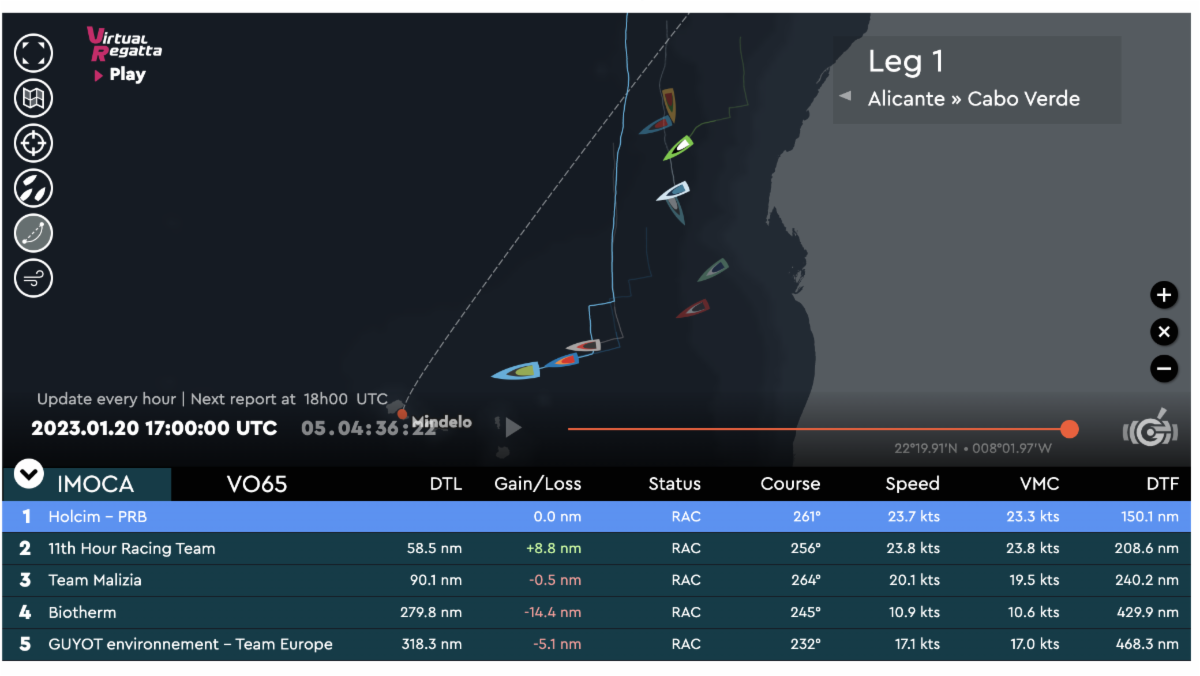
As of Friday 12:30 p.m., in second place, Enright and his crew are closing on the finish of Leg 1 at Mindelo, Cape Verde Islands, having sailed nearly 1900 nautical miles already. They’ll soon head for a second stop in Cape Town, South Africa and then sail 12,750 miles across the Southern Ocean, around Cape Horn, and land in Itajai, Brazil. On the fourth of the race’s seven legs, the fleet will depart Brazil on April 23, and sail north in the Atlantic to Newport, arriving in the second week of May.
Will Third Time Be a Charm?
The Ocean Race (previously the Volvo Ocean Race) landed at Fort Adams in 2015 and 2018. Both times, the stopovers were organized and hosted by Sail Newport, the public-access sailing non-profit based at the Fort, and both times, Charlie Enright skippered a boat home to Narragansett Bay, where he grew up sailing at the Bristol Yacht Club.
“It’s pretty surreal to be doing what I am doing, period,” says Enright. “But then to have my participation in the race coincide with Newport as a stopover is nuts.
“What we’ve yet to do is win a leg into Newport,” he adds. “That’s clearly the goal.”
About his outlook on the race as a whole, Enright says, “If we just go out there and be ourselves and do what we’ve had confidence in, we should be in a pretty strong spot. That said, it’s one thing to be the boat that’s sailing the best at the beginning of the race, it’s another thing to be the boat sailing the best at the end of the race and being the boat that’s most improved over the course of the race. So those continue to be goals as well.”
Enright, 38, has won plenty of trophies over the years. In his early days of sailing, he says, “The July Sail Newport Regatta was our big field trip every year. I think I won the event as a kid in a 420, a Vanguard 15 and a J/24 and later as a professional in 12-Meter, and a Swan 42.”
Enright earned a degree at Brown University, where he sailed with distinction on the dinghy team, earning honorable mention on the All-America Team three times. But ocean sailing called to the young sailor even then.
While still in school, he was among those chosen when Roy Disney recruited and trained a youth crew, then loaned them his TP52, Morning Light, to compete in the 2007 Transpacific Yacht Race from L.A. to Hawaii. He also met his future sailing partner, Mark Towill, during the program. The latter, a high school student in Hawaii, followed Enright to Brown, and the two sailors stayed in touch. By Towill’s senior year, they were working together on a sponsored offshore race program, which led to raising funds to charter a boat for a youth team in the 2011 Transatlantic Race to Germany and later saw them join the Volvo Ocean Race business development program.
In the Volvo Ocean Race, they placed fifth overall, both in 2015-2016 aboard their Team Alvimedica and in 2017-2018 with Vestas 11th Hour Racing. Now as 11th Hour Racing Team, the pair has a fully funded program and a good head start building and tuning Mālama ahead of the rest of the fleet.
Yet there have been new challenges. Instead of racing boats all of the same design, the organizers have chosen boats built to the IMOCA 60 rule. Each boat has a different shape and different foils that can lift part of the boat clear of the water to reach exceptional speeds.
Going Back to School
“We’re coming from a one-design background,” says Enright. “This game is more complex. The biggest change isn’t necessarily the class; we’re designing and building our own tool for the first time.”
The IMOCA boats are typically sailed with only one or two sailors aboard, but The Ocean Race will sail with four sailors on each boat plus the Media Crew Member. That’s half the crew that sailed in the previous Volvo Ocean Race 65s. On the other hand, the team required to build, design, and manage the boat has grown from 5 shore crew to 30. That led Enright and Towill to the mutual decision that Towill would stay ashore and take on the job of CEO, a role he has embraced, even as he went back to school and completed an MBA at Babson College.
As skipper, that left Enright in charge of the boat, and there was only one place for him to go to school—Brittany, the epicenter of IMOCA sailing, on the west coast of France, the best place to buy a practice boat, begin training, and then build the new boat they would use for the race.
Brittany has bright minds, quality boatbuilders, and intelligent engineers, says Enright. And looking beyond offshore racing, he adds, you notice the amount of French influence in other high-level racing. For example, the designer of Mālama is Guillame Verdier, who Enright says invented the America’s Cup’s 75-foot foiling catamarans.
In 2019, 11th Hour Racing Team acquired the former Hugo Boss, an IMOCA 60 built in 2015, one of the first IMOCAs with a carbon-fiber hull and lifting foils to reduce drag and increase speed. At the same time, the team started a two-year process of designing and building their new IMOCA 60 in CDK Technologies, in Lorient, France.
Enright began racing the practice boat that fall, finishing a strong fifth with French veteran Pascal Bidegorry as sailing partner in the double-handed Transat Jacques Varbre race from France to Brazil. Training and subsequent race opportunities continued, with Enright assembling an experienced crew of sailors, each with around the world races on their resume: five-race veteran navigator Simon Fisher (GBR), Justine Mettraux (SUI), Jack Bouttell (GBR/AUS), and Francesa Clapcich (ITA), who is also a two-time Olympic sailor. Once the new boat was launched in 2021, crew members often sailed in IMOCA races aboard both boats, often with two crew aboard each.
Referring to Brittany, Enright says, “What surprised me was the scale of it, and the organization. You may think of French offshore sailors as winging it, but when you do a deep dive, they are really organized and collaborative. We did training sessions with 10 to 15 boats, all sharing data, all debriefing together.
“There is this perception that it’s a tight-knit closed group and to some extent it can be, but we’re glad to have been there and appreciate how we were welcomed.”
Sustainability at the Core of Operations
Adding yet another layer of complexity to the construction of Mālama and to all of their operations, Enright and Towill’s 11th Hour Racing Team raised the bar by challenging themselves to build a winning boat while reducing and reporting on the sustainability impact of each phase of the build. Mālama is Hawaiian for “to care for, protect and preserve.”
The Team’s goal, besides building the tool that Enright needs to win the race while minimizing environmental impact, has been to inspire positive action to create long-lasting change for ocean health. With the appointment of sustainability team members, they worked with CDK and key suppliers in Brittany to address issues ranging from where recycled carbon fiber could be used in the hull construction to packaging and transport of supplied components.
“Every aspect of our campaign is looked at through a sustainability lens,” says Enright. “We look at performance, price, and sustainability, and everything is in that cost/benefit matrix.”
Did that result in serious performance compromises?
“One of the great things about our title sponsor, 11th Hour Racing, is they understand these goals are lofty, and they take time and resources,” Enright says. “It’s a bit of a double-edged sword, because to speak credibly about the advancements of sustainable practices, you need to succeed and show everybody you’re doing it without compromise to performance and safety.
“We acknowledge that today the best way to construct a boat if you’re looking for something that’s light and strong is to make it out of carbon fiber, but we also have recycled carbon fiber on our boat which has 90 percent less footprint than virgin cloth, we’ve got flax, we’ve got bamboo, we’ve got bioresin—if we don’t experiment with these materials, who will? Then things will never change.”
Heading for the USA
As the race from Alicante, Spain, unfolds—and certainly by May—we’ll have a good idea how well the U.S. team made its choices, both in building and sailing Mālama for nearly 25,000 miles. But one thing is for sure already; when the race reaches the United States, the sailing-centric state of Rhode Island will be out in force to greet Charlie Enright’s team and crew including Newport’s Amory Ross who serves as the media crew member, and the rest of the IMOCA fleet.
“One of my proudest moments came in 2018, the second time we hosted the race,” says Brad Read, executive director of Sail Newport. “Thousands of people came to greet the fleet in the middle of the night and celebrated a true Rhode Island welcome.”
Enright’s message to fans, who will travel from all over to be in Newport, is simple and heartfelt: “We appreciate your support. Don’t ever underestimate how much it means to us and drives us to succeed. We’re humbled by it and very lucky to be part of the sailing community.”
Image Top: Skipper Charlie Enright in the cockpit of 11th Hour Racing Team’s Malama during racing on Leg 1, day 4 of The Ocean Race. (Image: January 18, 2023, Amory Ross/11th Hour Racing Team/The Ocean Race)
TheOceanRaceNewport.comhttps://sailnewport.org/wp-content/uploads/2023/01/or2.pnghttps://sailnewport.org/wp-content/uploads/2023/01/or3.png
Co-Hosts
https://sailnewport.org/wp-content/uploads/2023/01/co-hosts.pnghttps://sailnewport.org/wp-content/uploads/2023/01/map.png
How to follow the race:
The Ocean Race Newport: https://www.theoceanracenewport.com
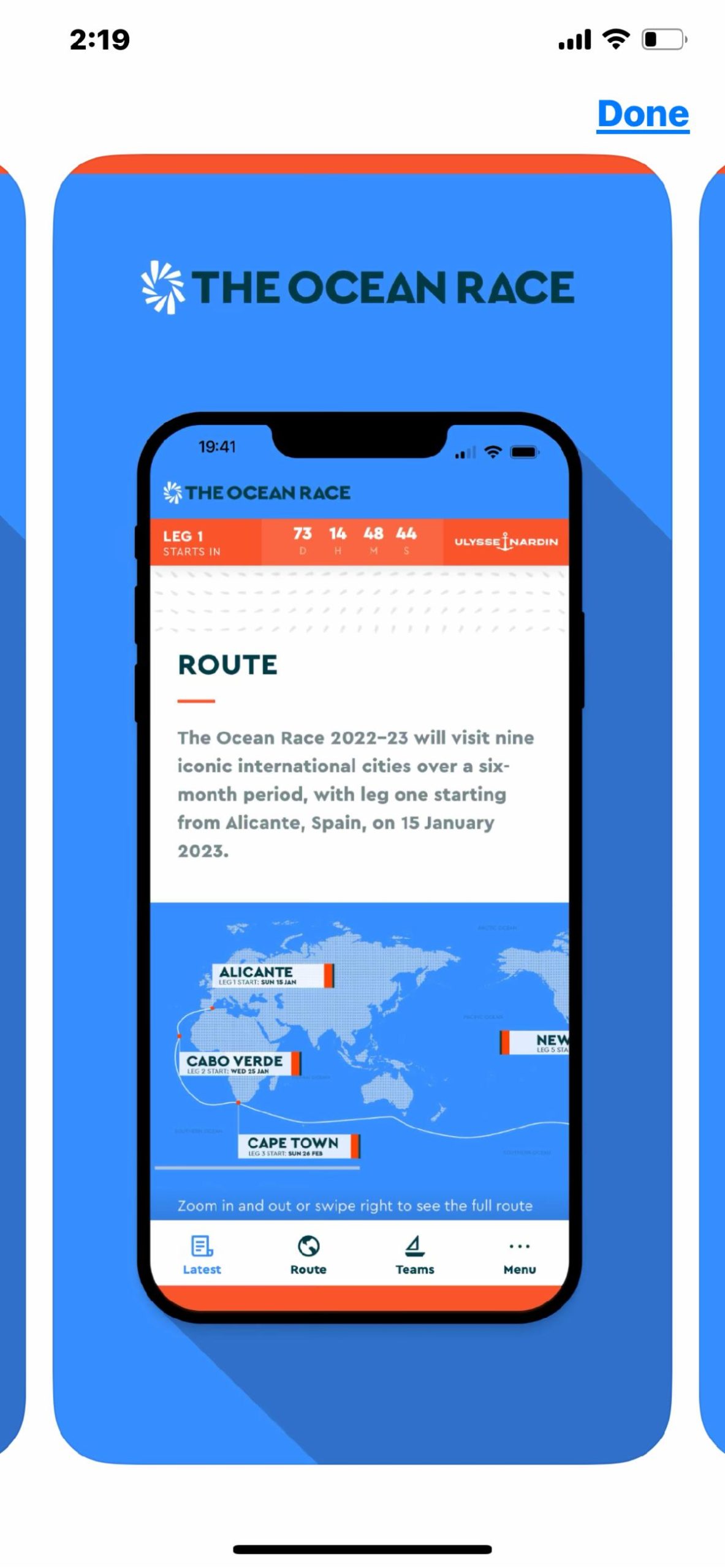
Download the App: The Ocean Race – watch from your phone and track the races, check on the teams, access the route, stay updated on the news, follow social media